Police jobs in Pakistan Application Process


Master the Police jobs in Pakistan application process with our ultimate guide. Learn about ranks, eligibility, physical tests, written exams, and how to apply online step-by-step for a career in Punjab, Sindh, KPK, or Balochistan Police.
A career in the police force is one of the most respected and challenging paths in Pakistan. It offers a unique opportunity to serve the nation, ensure public safety, and build a stable career with honor and prestige. However, the Police jobs in Pakistan application process is known for being rigorous and highly competitive, designed to select only the most capable and dedicated candidates.
Whether you aspire to become a brave Police Constable, an elite ASI, or a commanding Police Officer (DSP/ASP), understanding the intricate application process is your first crucial step. This ultimate guide will demystify every stage, from initial eligibility to final selection. We will provide a detailed, step-by-step breakdown of the process for different ranks, along with essential preparation tips to maximize your chances of success.
Browse All Latest Punjab Police Jobs in Pakistan Here
Understanding the Structure: Ranks and Roles in Pakistan Police
Before you apply, it’s vital to understand the hierarchy and the different types of positions available. The application process varies significantly depending on the rank.
Lower Staff (Constable, Head Constable, Driver, Clerk)
- Roles: Frontline law enforcement, traffic management, administrative support, and technical duties.
- Application Process: Typically involves a physical test, written exam, interview, and medical examination. Often advertised at the provincial level.
Also Check: Constable Jobs 2025 – 3229 Posts | Federal Constabulary
Intermediate Staff (Assistant Sub-Inspector – ASI)
- Roles: Investigation, in-charge of a police post, assisting Sub-Inspectors and Inspectors.
- Application Process: More stringent than for lower staff. Requires a higher intermediate level of education. Involves a detailed written exam, physical test, and interview.
Officer Ranks (Sub-Inspector SI, Inspector)
- Roles: Leading police stations, investigating major crimes, and supervising junior staff.
- Application Process: Highly competitive. Requires a bachelor’s degree. Involves a comprehensive written exam, physical assessment, psychological testing, and a detailed interview.
Elite Officer Ranks (Deputy Superintendent of Police – DSP/ASP)
- Roles: Senior command and leadership positions. DSPs are recruited through provincial public service commissions, while ASPs are recruited through the Federal Public Service Commission (FPSC).
- Application Process: The most demanding process, identical to other civil services. It requires a university degree and involves passing the extremely competitive CSS examination conducted by the FPSC.
Are You Eligible to Apply?
Eligibility criteria are strict and non-negotiable. While they can vary slightly by province and specific recruitment drive, the general requirements are:
Nationality & Domicile
- Must be a citizen of Pakistan.
- Must hold a valid domicile certificate of the province you are applying to (e.g., Punjab Police requires a Punjab domicile).
Age Limit
Age limits are calculated from the last date mentioned in the job advertisement.
- Constable: 18 to 22 years
- ASI: 18 to 25 years
- SI: 20 to 28 years
- DSP/ASP (via FPSC): 21 to 30 years
- Age relaxation is often available for certain categories as per government policy.
Educational Qualification
- Constable: Matric (Secondary School Certificate)
- ASI: Intermediate (FA/F.Sc)
- SI & Inspector: Bachelor’s degree (BA/B.Sc) from a recognized university
- DSP/ASP: Bachelor’s degree (minimum 2nd division) for FPSC CSS.
Physical Standards
This is a critical barrier. Failure to meet these standards leads to immediate disqualification.
- Height:
- Men: 5′ 7″ to 5′ 10″ (varies by province and role)
- Women: 5′ 2″ (minimum)
- Chest (For Men): 33″ to 34.5″ (unexpanded/expanded)
- Running: Must complete a distance (e.g., 1.6 km) within a specified time (e.g., 7 minutes).
- Chin-ups/Push-ups: A minimum number is required.
- Vision: Must meet the required standards; color blindness is a disqualification.
Pro Tip: Start a rigorous physical training regimen at least 3-6 months before you plan to apply.
The Step-by-Step Police Jobs Application Process
The journey from seeing an advertisement to finally wearing the uniform involves multiple stages. Here’s a detailed breakdown.
Step 1: Finding the Job Advertisement
Official Sources: Vacancies are advertised in leading national newspapers (Dawn, Jang, The News) and on the official websites of the respective police forces:
Job Portals: Reputable job sites like ApplyKrdo.com aggregate these advertisements. You can find the latest police job ads here.
Step 2: Application Submission
The application process has largely moved online.
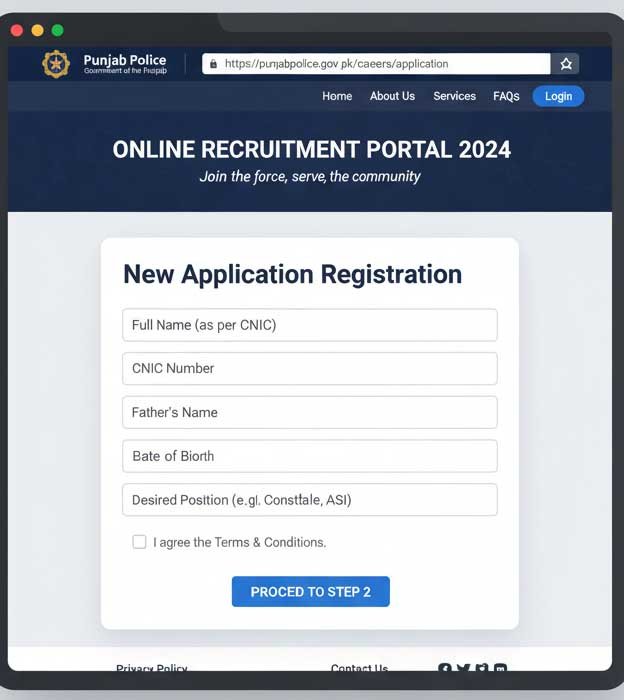
- Online Registration: Visit the official police jobs portal mentioned in the ad. You will need to create an account using your CNIC and a valid email address.
- Filling the Form: The form will require:
- Personal Details (Name, Father’s Name, DOB)
- Contact Information (Address, Phone Number)
- Academic Details (Marks, Grades, Year, Board/University)
- Domicile Information
- Uploading Scanned Documents: Recent photograph, CNIC, Domicile, Educational Certificates.
- Application Fee: Submit the required fee via a bank challan generated through the portal. Keep the receipt.
Step 3: The Initial Physical Test
Shortlisted candidates are called for a physical test at a designated center.
- What to Expect: Height, weight, and chest measurement check. Followed by physical efficiency tests like running, push-ups, chin-ups, and long jumps.
- Preparation: Practice running daily. Include strength training (push-ups, pull-ups) in your routine.
Step 4: The Written Examination
Candidates who pass the physical test are called for a written exam.
Exam Pattern: Usually MCQs. Tests knowledge on:
- General Knowledge (Pakistan, Islamic Studies, Current Affairs)
- English/Urdu Grammar & Comprehension
- Basic Mathematics
- Analytical Reasoning
- Subject-specific knowledge for higher posts
Preparation: Use books on general knowledge, practice English and Math from intermediate-level textbooks, and solve past papers if available.
Step 5: The Interview and Psychological Assessment
- Interview: A panel interviews you to assess your confidence, communication skills, motivation, and moral character. Be honest, respectful, and clear about why you want to join the police.
- Psychological Assessment: For higher ranks, you may undergo psychological testing to evaluate your emotional stability, decision-making under pressure, and integrity.
Step 6: Medical Examination & Final Selection
- A thorough medical check-up is conducted by designated government doctors to ensure you are physically and mentally fit for the demanding job.
- A final merit list is prepared based on scores from the written test, interview, and physical test. Selected candidates are sent to police training academies.
Preparation Strategies: How to Ace the Process
Physical Preparation:
- Running: Start with slow jogs and gradually increase your speed and distance. Aim to run 1.6 km under 6:30 minutes.
- Strength Training: Do at least 20-30 push-ups and 5-10 chin-ups in a set. Practice daily.
- Measurements: Ensure you meet the height and chest requirements before applying.
Academic Preparation:
- GK & Current Affairs: Read newspapers daily. Use a good GK book for competitive exams.
- Math & English: Revise Matric and Intermediate level syllabus. Practice grammar and comprehension.
- Past Papers: Search online for past papers of police exams to understand the question pattern.
Common Mistakes to Avoid
- Waiting for the Last Day: Don’t wait until the deadline to apply online. Technical glitches are common.
- Incorrect Form Details: Double-check all information, especially your name, date of birth, and grades, against your documents. Discrepancies lead to lifetime disqualification.
- Poor Physical Preparation: Underestimating the physical test is the most common reason for failure.
- Neglecting Academic Prep: Assuming the written test is easy. It is highly competitive and requires dedicated study.
- Unprofessional Behavior: Be respectful and professional during the interview and all interactions with officials.
Frequently Asked Questions
Can females apply for police jobs?
Absolutely. All provincial police forces have specific quotas and welcome female applicants. Physical standards are adjusted accordingly.
Is there any quota system?
Yes, quotas exist for minorities, women, and certain districts. Details are always mentioned in the job advertisement.
What is the starting salary for a Police Constable?
The starting salary (including all allowances) for a constable in a provincial police force can range from PKR 35,000 to PKR 45,000.
How long is the training period?
Basic training can last from 6 to 9 months, depending on the rank and province.
I wear glasses. Can I apply?
Yes, but your vision must be correctable to the required standard. Specific rules are outlined in the medical requirements.
Conclusion: Your Pathway to a Noble Profession
The Police jobs in Pakistan application process is a demanding marathon, not a sprint. It tests your physical prowess, mental sharpness, and moral character. While the path is challenging, it is incredibly rewarding for those who are determined and well-prepared.
By understanding each step, preparing thoroughly, and avoiding common pitfalls, you can significantly increase your chances of succeeding. Remember, persistence and dedication are key qualities the police force looks for. Your journey to serving the nation and building a respected career starts with a single, well-prepared application.
Ready to take the first step? Find the latest police job opportunities and launch your career today!